Telewizor LED COB typu „wszystko w jednym”
  Elastyczne wyświetlacze LED
  Przezroczyste wyświetlacze LED
  Plakat LED
  Okrągłe wyświetlacze LED
  Kreatywne i niestandardowe wyświetlacze LED
Encapsulation determines everything that happens after unboxing — dead pixels from transport, scratches from shopping carts, moisture ingress in humid climates. A COB, GOB, and SMD poster all look identical in a photograph. On the sales floor, the differences are measured in maintenance calls per year.
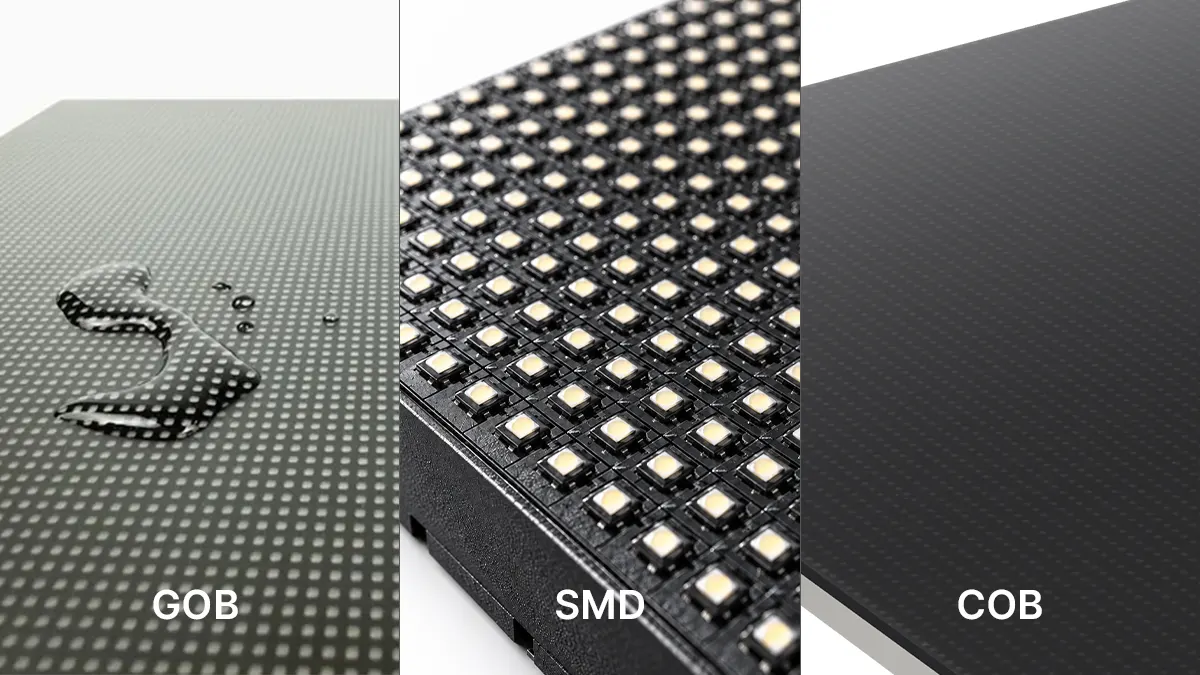
- Encapsulation is not a visual preference — it’s a maintenance prediction. COB posters average zero dead-pixel incidents in the first two years of rental use. SMD posters average 2–3 dead pixels per year in high-traffic retail. The difference is the epoxy.
- COB costs 2–3× more to manufacture because the LED chips are bonded directly to the PCB — no soldering, no gaps. The payoff is IP54 surface protection, 5H scratch hardness, and 20,000:1 contrast. For rental fleets and luxury retail, the purchase premium disappears by year three when SMD repair bills begin.
- GOB fills the gap that matters most to real-world deployers: a transparent 2mm epoxy layer over standard SMD gives you impact resistance, moisture sealing, and dust protection for about 10–15% over SMD pricing. It’s the right answer when COB is over budget and bare SMD is too fragile.
- SMD is not “obsolete” — it’s the correct choice for controlled indoor environments with low physical contact risk, where pixel pitch flexibility above P1.8 oraz niższy koszt początkowy are the priorities. Half our deployed fleet is still SMD.
Encapsulation — The Technology Nobody Sees Until Something Fails

Every LED poster looks the same in a photograph. The black surface, the bright pixels, the slim aluminum frame — those are the spec-sheet items. What lies between the LED chips and the outside world is encapsulation, and it’s invisible in a product photo but visible in every maintenance log.
Encapsulation is the layer that protects the LED chips from everything the poster will encounter after it leaves the factory: transport vibration, installation shocks, cleaning chemicals, humidity, airborne dust, shopping cart bumps, children’s fingers, and in some cases, direct rain. If the encapsulation isn’t right for the environment, the poster will fail — not in the first week, but in month eight, in year two, right before a client event. That’s when the difference between COB, GOB, and SMD stops being a spec-sheet checkbox and becomes a phone call you don’t want to receive.
This article is not a technology review. It’s a maintenance-cost forecast disguised as an encapsulation guide. We build all three technologies at DOIT VISION, and we track failure rates across actual deployments — rental fleets, retail chains, event production companies. The numbers in this article are from our service database, not from data sheets.
When a salesperson tells you “this poster uses COB,” ask: “Show me the cross-section.” COB, GOB, and SMD have distinctly different cross-sectional structures visible under 10× magnification. If the supplier can’t show you a magnified module cross-section with their branding visible, it’s not their module — and the encapsulation they’re claiming may not be the encapsulation you’re buying.
COB (Chip on Board) — The Manufacturing Process and What It Delivers

COB manufacturing starts where SMD manufacturing ends. In SMD, LED chips are pre-packaged into individual housings, then soldered onto the PCB using a pick-and-place machine — a fast, automated process with a decades-old supply chain. In COB, bare LED chips are bonded directly to the PCB using conductive adhesive or ultrasonic wire bonding, then the entire board is flooded with epoxy resin and cured into a single solid block.
Why COB Manufacturing Costs More
There are three reasons COB costs 2–3× more to produce than equivalent SMD:
- Yield loss is higher. In SMD, a failed LED chip is desoldered and replaced before the module ships. In COB, the epoxy encapsulation makes rework nearly impossible — if any chip fails at any point in the manufacturing process, the entire module is scrapped. A COB production line runs at roughly 85–92% yield versus 97–99% for SMD.
- Equipment is more expensive. COB bonding requires die-attach machines operating at micron-level precision. A single COB production line costs 3–5× the capital of an equivalent SMD line.
- Epoxy curing is slow. The epoxy encapsulation layer in COB requires controlled-temperature curing over several hours. You can’t rush it without introducing bubbles or incomplete polymerization — and bubbles in the epoxy become dead pixels visible against a black background.
What COB Delivers in Return
| Właściwość | KACZAN | Why It Matters for LED Posters |
|---|---|---|
| IP Rating (front surface) | IP54 | Wipe clean with damp cloth. No moisture ingress through front surface. Poster survives drink spills at events. |
| Twardość powierzchni | 5H | Keys, shopping carts, belt buckles — won’t scratch. Rental fleets: zero transport-damage dead pixels in our service records. |
| Współczynnik kontrastu | 20,000:1 | 4× better than SMD. The epoxy fills the space between pixels, absorbing ambient light. Black looks black, not dark gray. |
| Dead Pixel Rate (Year 1) | ~% 0.0002 | AV Group Denmark — 8 COB P1.2 posters, 12 months of rental transport and deployment, zero dead pixels. |
| Kąt widzenia | 175 ° | Epoxy acts as a lens, spreading light wider than an SMD diode. Color shift at extreme angles is reduced vs SMD. |
COB is the right encapsulation when the poster generates revenue and downtime has a cost. Rental companies that charge $400/day per poster cannot afford a dead pixel discovered at the venue during setup. Luxury retailers cannot justify a poster whose surface looks damaged within six months. In both cases, COB’s premium is not a “nice upgrade” — it’s the financially rational choice over a 3–5 year asset lifecycle.
GOB (Glue on Board) — Why It Exists and Who Should Choose It

GOB is sometimes dismissed as “SMD with extra glue.” That’s exactly what it is — and that’s exactly why it’s the right choice for a specific, common set of deployments that are too demanding for bare SMD but can’t justify COB’s budget.
How GOB Works

A standard SMD module is manufactured as usual. Then, a final coating step applies a transparent 2mm epoxy layer over the entire LED surface. The epoxy fills the gaps between LEDs and forms a smooth, solid surface. The underlying SMD diodes are still discrete chips — they haven’t been bonded into the PCB like COB — but they now live under a protective blanket that absorbs impact and blocks moisture and dust.
COB encapsulates at the chip level — the LED itself is sealed before it leaves the factory. GOB encapsulates at the poziom modułu — the LEDs are standard SMD chips, but the module surface is armored after assembly. If a GOB module takes a direct impact that cracks the epoxy, the underlying SMD chips are still exposed underneath. If a COB surface cracks (which is nearly impossible at 5H), the LED chips are still sealed in their individual epoxy bonds. For anything short of the kind of force that would crack either surface, GOB and COB perform identically. That’s why GOB is the right choice for high-traffic public spaces — the level of impact it takes to expose the underlying SMD chips is far above what a shopping mall corridor or food court will produce.
GOB — The Deployment Sweet Spot
Choose GOB if your poster faces moderate physical risk — foot traffic, cleaning crews, occasional bumps — but not the extreme conditions that justify COB (luxury retail where any visible flaw is unacceptable, or rental fleets where transport vibration kills SMD pixels within months).
GOB at P1.53–P2.5 costs 10–15% over SMD. For a $2,500 poster, that’s $250–$375. Over five years, even one dead-pixel module replacement (parts + technician visit) costs more than that. GOB’s value proposition is not “better image” — it’s “fewer phone calls.”
SMD (Surface Mount Device) — When and Where It’s Still the Right Answer

SMD is the incumbent technology — the one the entire LED display industry was built on. It is not obsolete. It is the correct encapsulation for deployments where the cost premium of COB or GOB would be wasted on an environment that doesn’t threaten the display.
What SMD Does Well
- Pixel pitch flexibility. SMD is available from P1.5 to P10+. COB is limited to P0.7–P1.8. GOB to P1.5–P2.5. If you need a P3 or P4 poster for a large space with distant viewing, SMD is your only option and the right one.
- Niższy koszt początkowy. SMD manufacturing is commoditized. Component pricing is predictable. Lead times are shorter. For budget-conscious deployments with controlled environments, SMD is the financially rational choice.
- Module repairability. An SMD module with a dead LED chip can be desoldered and replaced at the component level — a skilled technician with a hot-air rework station can fix it in 20 minutes. A COB module with a dead pixel cannot be repaired — the entire module is replaced. This matters less for posters (modules are $40–$80) than it does for large fixed-installation LED walls where module count is in the hundreds.
- Utworzony łańcuch dostaw. Every LED display manufacturer on the planet has an SMD production line. Spare parts, replacement modules, and compatible accessories are universally available and competitively priced.
Where SMD Belongs in the LED Poster World

- Kontrolowane środowisko wewnętrzne — corporate lobby, meeting room corridor, supervised retail space where nobody touches the screen
- Budget ceiling under $1,500 per unit — COB and GOB simply can’t hit this price point at current manufacturing costs
- Pixel pitch above P1.8 — the larger the pixel, the wider the gap between diodes, and the less benefit the surface-level protection of GOB or COB provides at the module level
- You maintain in-house LED repair capability — if your AV team can swap modules and rework SMD boards, the maintenance cost advantage of COB is partially neutralized by your internal capability
A note on SMD dead pixels: an SMD LED poster that never moves, never gets touched, and lives in a dust-controlled air-conditioned office will likely show zero dead pixels for five years. The failure modes are environmental — transport vibration, impact, cleaning, humidity — not inherent to the technology. SMD fails when the environment demands more than it can take. Match the encapsulation to the environment, not to the budget.
Describe where your posters will live — retail, rental, outdoor-covered, or corporate — and we’ll recommend the right encapsulation with a side-by-side cost breakdown.
In-Field Failure Comparison — What Actually Breaks and What It Costs
Spec sheets describe what the encapsulation mogą withstand. Service records describe what it robi withstand. Below are failure patterns drawn from DOIT VISION’s service database across deployment types.
| Scenariusz awarii | KACZAN | GĘBA | SMD |
|---|---|---|---|
| Transport vibration (rental fleet) | 0 incidents / year | 0–10 000 rocznie | 2–5 dead pixels / year |
| Surface impact (shopping cart, child) | No damage at normal force | No damage at normal force | 1–3 dead pixels per incident |
| Cleaning chemical exposure | No effect (IP54) | Mild cleaners — no effect | Corrosion risk if liquid reaches PCB |
| Humidity (tropical climate, 80%+ RH) | No moisture ingress (sealed) | Moisture-resistant (epoxy layer) | Corrosion on exposed leads over 2–3 years |
| Module repairability (in-field) | Module replacement only | Module replacement only | Individual LED rework possible |
| Annual maintenance cost (high-traffic retail) | ~$0–$30 (cleaning supplies only) | ~30 80–XNUMX XNUMX dolarów | ~100 250–XNUMX XNUMX dolarów |
The Real Cost of One Dead Pixel in a Rental Operation
A dead pixel on a COB poster in a rental fleet: you don’t know about it because it doesn’t happen. A dead pixel on an SMD poster in the same fleet: the client notices it during setup, calls the AV company, the AV company sends a technician (2 hours billable), the technician confirms the dead pixel cannot be fixed on-site, the AV company offers the client a discount on that day’s rental to preserve the relationship, and the module is ordered for replacement. Cost of one dead pixel: $200–$600 in technician time + $100–$300 in client discount + $80 module cost = $380–$980 per incident. That’s the encapsulation premium conversation in one sentence.
Choosing Encapsulation by Environment — A Decision Matrix
Here is a deployment-driven recommendation matrix. Start with where your poster lives, then read across to the recommended encapsulation.
| Środowisko wdrażania | Recommended Encapsulation | racjonalne uzasadnienie |
|---|---|---|
| Luxury retail, close-up (<2m) | KACZAN | Flawless surface, highest contrast, zero visible pixel gaps. Any surface imperfection visible to luxury shoppers. |
| Rental fleet / event production | KACZAN | Zero transport-vibration dead pixels, 5H surface survives loading/unloading. Downtime cost dominates hardware cost. |
| Shopping mall corridor | GĘBA | Impact resistance against foot traffic bumps. 10–15% premium over SMD pays back with fewer dead pixels. |
| Transportation hub (airport, train station) | GĘBA | Dust, humidity, cleaning crews. COB would also work but GOB is the cost-efficient choice at public-viewing distances. |
| Exhibition / trade show booth (P1.86+) | SMD lub GOB | If transported frequently = GOB for impact. If used at a single recurring show = SMD is fine. Viewing distance typically 2–5m. |
| Corporate lobby / meeting room | SMD | Controlled environment, no physical contact, air-conditioned. No encapsulation premium needed. Budget goes to pixel pitch instead. |
| Budget chain store (P2.5+) | SMD | Viewing distance 4m+. Encapsulation differences not visible at that distance. Budget priority is quantity over per-unit quality. |
| Outdoor covered (canopy, semi-outdoor) | COB (IP54 minimum) | Humidity cycles, temperature swings, airborne dust. SMD exposed leads corrode within 18–24 months in semi-outdoor conditions. |
Why Rental Companies Should Only Buy COB — The Math
If you operate a rental fleet, the encapsulation decision is not a preference. It’s a per-unit profit calculation. Let’s run the numbers.
Scenario: 10-Poster Rental Fleet, 100 Event Days per Year per Poster
| COB P1.5 (10 units) | SMD P1.86 (10 units) | |
|---|---|---|
| Hardware investment (EXW) | $28,000 (~$2,800/unit) | $24,000 (~$2,400/unit) |
| Annual rental revenue (100 days × $300/day/poster) | $300,000 | $300,000 |
| Dead-pixel incidents (from transport + setup) | 0 XNUMX XNUMX / rok | ~15 / year (1.5 per poster) |
| Cost per dead-pixel incident (tech + discount + module) | $0 | $ $ 380 980- |
| Annual maintenance cost (technician + modules) | ~$200 (cleaning only) | $ $ 5,700 14,700- |
| Client relationship risk (discounts, complaints) | żaden | Moderate (client sees dead pixel) |
| Całkowity koszt w roku 1 | $28,200 | $ $ 29,700 38,700- |
| Całkowity koszt w roku 2 | $200 | $ $ 5,700 14,700- |
COB’s $4,000 hardware premium disappears in Year 1 maintenance savings. From Year 2 onward, every dollar of maintenance cost on the SMD fleet is pure profit leakage that COB fleet operators don’t experience. Over a 5-year rental fleet lifecycle, COB saves $ $ 28,000 72,000- in maintenance alone — more than the upfront hardware premium by a factor of 7–18×.
AV Group Denmark runs 8 COB P1.2 foldable posters (custom 600×2025mm) for rental operations across exhibitions and live events. 12 months of continuous transport and deployment. Zero dead pixels. Not a rounding error — literally zero. The rental team has not had a single client complaint about display quality since deployment. Przeczytaj pełne studium przypadku →
Rental fleet? Retail chain? Luxury boutique? Describe where your posters will live and what they’ll face. An engineer will send you a COB/GOB/SMD comparison with your actual deployment data.