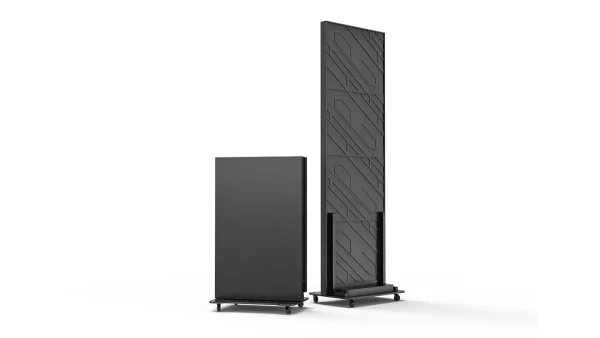
Telewizor LED COB typu „wszystko w jednym”
  Elastyczne wyświetlacze LED
  Przezroczyste wyświetlacze LED
  Plakat LED
  Okrągłe wyświetlacze LED
  Kreatywne i niestandardowe wyświetlacze LED
 Unit price says LCD. TCO, brightness, seamless splicing, and the bezel problem say otherwise. A side-by-side comparison for retail chains, event producers, and AV integrators choosing between the two.

- LCD wins on single-unit purchase price — a 55″ commercial display costs $800–$1,500. An LED poster starts at $980. But the comparison becomes meaningless beyond one unit: LCD cannot be spliced seamlessly into a large display without visible bezel gaps, while LED posters can be linked into a continuous wall of any size.
- LED posters deliver 2–3× the brightness of standard commercial LCDs (800–1,200 nits vs 350–500 nits). In any environment with windows, spotlights, or open ceilings, the brightness gap is the single biggest factor in content legibility.
- At 3–4 units and beyond, LED poster TCO undercuts LCD when factoring in the mounting hardware, separate media players, video wall controllers, and calibration labor that LCD video walls require.
- LCD holds one strong advantage: built-in Android OS with plug-and-play content management — no external controller, no learning curve. For a single display in a small business, LCD is genuinely simpler.
Unit Price vs Total Cost — The Question Most Buyers Get Wrong
When a retail chain or event company starts researching digital signage, the first comparison is almost always the same: “LED poster vs LCD — which is cheaper?” The answer depends entirely on what “cheaper” means.
On unit price alone, LCD wins. A 55″ Samsung or LG commercial display runs $800–$1,500. A 65″ unit: $1,200–$2,200. An LED poster starts at $980 for a P2.5 Indoor Poster and climbs to $4,600 for a P1.25 COB Poster.
But that’s one poster versus one screen. The moment the comparison shifts to “how do I cover a 4-meter-wide storefront window,” the math flips entirely. Covering that space with LCD requires four 55″ panels in a 2×2 grid, a video wall controller ($500–$2,000), a mounting frame ($300–$800), and professional calibration — bringing your total to $5,000–$9,000 before content. Covering it with LED posters needs only two units spliced seamlessly, with no bezels, no separate controller, no calibration — roughly $2,000–$7,000 installed.
LCD panels have bezels. Even the thinnest “bezel-less” commercial displays have a 0.88mm bezel-to-bezel gap between adjacent panels. In a 2×2 video wall, that’s a 1.76mm black cross running through the center of your content. On a luxury brand campaign or a product reveal, that cross is unacceptable — which is why high-end retail has moved to LED. LED modules connect edge-to-edge with zero visible gap. The image is continuous, regardless of wall size.
This article walks through every variable — not to declare one technology “better,” but to show you exactly where the cost lines cross, so you can match the right display to your specific deployment.
LED Poster vs LCD Digital Signage — Spec Comparison at a Glance
| Specyfikacja | LED Poster (Indoor P2.5) | LCD Digital Signage (55″ Commercial) |
|---|---|---|
| Obszar wyświetlania | 640 × 1920 mm (1.23 m²) | ~680 × 1210 mm (0.82 m²) |
| Rozkład | 256 × 768 (varies by pitch) | 1920 × 1080 (Pełna rozdzielczość HD) |
| Jasność | 800–1,200 nitów | 350–500 nits (standard) · 700–2,500 (high-brightness) |
| Kąt widzenia | 160° poziomo / 140° pionowo | 178° H / 178° V (IPS) |
| Bezszwowe łączenie | Yes — zero bezel, any size | No — 0.88–3.5 mm bezel gap per join |
| Unit Price (EXW) | $ $ 980 4,600- | $ $ 800 2,200- |
| Pobór energii | ~160 W (P2.5, avg) | ~120–180 W (55″) |
| Lifespan (to half brightness) | 100,000 hours (~11 years @ 24/7) | 50,000 hours (~5.7 years @ 24/7) |
| Content Management | Novastar TB40 · VNNOX Cloud · USB · WiFi | Built-in Android SoC · Tizen/webOS · Plug-and-play |
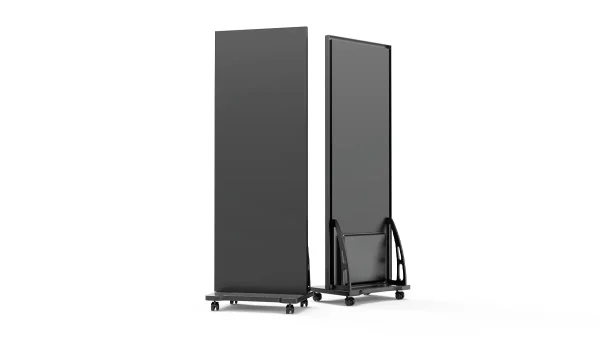
| Przenośność | Caster wheels, foldable options, 27–48 kg | Wall-mount or stand, 15–25 kg, not portable |
| Elastyczność proporcji | Any ratio — portrait is native (640×1920) | 16:9 fixed — portrait requires rotation |
The LED poster comparison uses the Indoor P2.5 model as the closest price-equivalent to a commercial 55″ LCD. Higher-spec LED posters (P1.25 COB) outperform LCD on every measurable dimension except resolution and built-in OS simplicity. All prices are EXW Shenzhen — freight and duties are additional.
Three-Year Total Cost of Ownership: One Unit, Side by Side
Purchase price is the first number you see. Ownership cost is the number that matters. Below is a three-year TCO comparison for a single-unit deployment — retail store, corporate lobby, or event space — running 12 hours per day, 365 days per year.
| Cost Line (3 Years) | LED Poster (Indoor P2.5) | LCD Digital Signage (55″ Commercial) |
|---|---|---|
| Cena za sztukę | $1,400 | $1,100 |
| Mounting / Stand | $0 (integrated caster base) | $120–$350 (wall mount or floor stand) |
| Media Player / Controller | $0 (integrated Novastar TB40) | $0 (built-in SoC) or $200–$500 (external player) |
| 3-Year Electricity | ~ $ 308 | ~231 346–XNUMX XNUMX dolarów |
| Konserwacja / Naprawy | $0 (under warranty) | $0 (under warranty) |
| 3-Year Single-Unit TCO | ~ $ 1,708 | ~1,451 1,796–XNUMX XNUMX dolarów |
At one unit, the gap is narrow. LCD starts cheaper but the mounting hardware narrows the margin. If the LCD needs a separate media player (not all do — many commercial displays now ship with embedded SoCs), the costs converge. The real separation happens at multi-unit scale — patrz rozdział 04.

Multi-Unit Deployment — Where LCD Costs Explode
This is the section where LED posters win — not by a little, but by a margin that makes the LCD route look like an accounting error. The reason is simple: LCD panels were designed to be used one at a time. When you connect them into a video wall, you pay for hardware you didn’t need before.
A 2×2 Video Wall — LCD vs LED Poster
Let’s compare covering a 4-meter-wide × 2.2-meter-tall wall — a typical retail storefront or hotel lobby feature wall.
| Linia kosztów | LCD 2×2 (4 × 55″ Panels) | LED Poster 2×1 (2 × P2.5 Posters) |
|---|---|---|
| Wyświetlaj jednostki | 4,400 dolarów (4 × 1,100 dolara) | 2,800 dolarów (2 × 1,400 dolara) |
| Kontroler ściany wideo | $ $ 800 2,000- | $0 (Novastar TB40 handles splicing) |
| Rama montażowa | $400–$800 (articulated video wall mount) | $0 (freestanding, caster base) |
| Kalibracja i konfiguracja | $400–$800 (professional calibration) | $0 (auto-calibrated, plug and splice) |
| Bezel Gap | 1.76–7.0 mm total gap (visible cross) | 0 mm (seamless) |
| Całkowity koszt instalacji | $ $ 6,000 8,000- | $2,800 |
At just two LED posters versus four LCD panels, the LED route costs 53–65% less — and delivers a larger, higher-brightness, seamless display. The LCD video wall controller alone costs as much as an entire LED poster. And the calibration? LCD panels drift over time — color and brightness uniformity degrade, and re-calibration is a recurring cost. LED modules are factory-calibrated and hold uniformity for their service life.
The Splicing Limit Multiplier
LED poster splicing scales linearly: 2 units = 2× the cost, 4 units = 4×, 8 units = 8×. No additional hardware. With LCD, every row and column you add requires a more expensive video wall controller — a 3×3 grid needs a 9-output processor ($1,500–$4,000), not the 4-output one you used for 2×2. The cost curve is superlinear for LCD, linear for LED.
A US retail chain needed a single seamless display per store — no bezels, bright enough for window frontage. LCD 2×2 per store: $6,000–$8,000 × 40 stores = $240,000–$320,000. LED Poster 1× per store: $1,400 × 40 = $56,000. The LED route saved $ $ 184,000 264,000- before the first campaign launched. Przeczytaj pełne studium przypadku →
Tell us your wall dimensions, viewing distance, and number of locations. We’ll send you an LED Poster vs LCD cost comparison within 24 hours.
Brightness and Ambient Light — Where LCD Falls Short
A standard commercial LCD display outputs 350–500 nits. That’s adequate for a dim conference room or a back-office corridor. It is niewystarczający for a storefront window with direct sunlight, a trade show floor with overhead halogens, or a hotel lobby with a glass ceiling.
LED posters start at 800 nits and range to 1,200 nits — roughly 2–3× jaśniejszy than standard LCD. In a window-front retail scenario, the difference is the difference between “I can see the content” and “I’m looking at a reflection of the street.”
High-Brightness LCD — The Catch
Yes, high-brightness LCD panels exist — 1,500–2,500 nits. They cost 3–5× więcej than standard commercial LCDs. A 55″ high-brightness panel runs $3,500–$5,500 — well above the $980–$1,400 range of an LED poster. At that price, you’re paying more for an LCD that still has bezels, still can’t splice seamlessly, and still runs a fixed 16:9 ratio. The LED poster gives you higher brightness, seamless splicing, a native portrait format, and costs less.
If your display will face any of these conditions, LED’s brightness advantage is decisive — not a “nice to have”:
- Storefront window with direct or indirect sunlight
- Stoisko targowe under exhibition hall lighting (800–1,200 lux typical)
- Hol lotniska or transportation hub with floor-to-ceiling glass
- Lobby hotelowe with skylight or open atrium
- Outdoor covered area (canopy, awning, semi-outdoor mall corridor)
If your display lives in a controlled indoor environment with no windows — a back office, a basement meeting room, a server-room dashboard — LCD is fine.
Content Management — Where LCD Genuinely Wins
We’re the factory that builds LED posters, so let’s be direct about where LCD is better: content management setup. A commercial LCD display ships with a built-in operating system — Samsung Tizen, LG webOS, or a generic Android SoC. You plug it in, connect to WiFi, install a digital signage app (ScreenCloud, OptiSigns, Yodeck), and you’re running content in 10 minutes. The learning curve is zero. The UI is what your store manager already knows from using a smartphone.
An LED poster requires a Novastar controller, and the content workflow — while not difficult — has a learning curve. You need Novastar’s software (NovaLCT or Viplex Handy) to configure the display and push content. It’s 30 minutes of setup instead of 10. For a single poster in a single location managed by a non-technical user, LCD’s simplicity is a real advantage.
Where LED Closes the Gap — Multi-Location Management
Managing 40 LCD displays across 40 stores with 40 different Android/Samsung/LG OS versions and 40 different app installations is nie proste. Each display needs its own account, its own configuration, its own troubleshooting. Managing 40 LED posters with Novastar VNNOX Cloud? One dashboard. Push content to all 40 simultaneously. Schedule by date, time, and location. Monitor health. Receive fault alerts. The US retail chain case study proved this: same-day campaign rollout across 40 stores from a browser — something their previous LCD fleet couldn’t do without visiting each location.
| Scenariusz | Plakat LED | LCD |
|---|---|---|
| Single unit, single location | 30-min setup, Novastar software | 10-min setup, built-in OS |
| 40 units, 40 locations | 1 dashboard, same-day push | 40 dashboards, 40 configs |
| Non-technical operator | USB plug-and-play (simplest) | Familiar smartphone-style UI |
| Enterprise IT-managed fleet | VNNOX Cloud — centralized | Third-party MDM required |
LED Poster or LCD — A Decision Framework
There’s no universal winner. There’s a right display for your specific deployment. Here’s the framework we use with clients.
Choose LCD Digital Signage When:
- You’re deploying exactly one display in a controlled indoor environment with no direct sunlight.
- Content resolution matters more than size. A 55″ 4K LCD at 2 meters looks sharper than a P2.5 LED poster at the same distance. For detailed dashboards, spreadsheets, or small text, LCD’s pixel density wins.
- A non-technical user needs to manage content with zero training — the built-in Android OS and app-store ecosystem make LCD genuinely simpler for single-unit deployments.
- Budget is under $1,000 total — LED posters start at $980 EXW before shipping. A $600 consumer TV with a $100 media player covers the basics.
Choose LED Poster When:
- You need multiple displays spliced into one seamless wall. This is LED’s killer feature — zero bezels, any size, linear cost scaling. LCD cannot compete here.
- Your display faces ambient light — windows, spotlights, open ceilings, exhibition halls. LED’s 800–1,200 nits make content visible where LCD washes out.
- Portability matters. If the display moves between locations, between events, or between campaigns, LED poster caster wheels and foldable options beat re-mounting an LCD every time.
- You’re deploying 3+ units — the video wall controller and mounting costs for LCD push the total above LED poster territory, and the bezel gaps become unacceptable.
- You need native portrait orientation. LED posters are built portrait-first (640×1920mm). LCD in portrait mode requires a rotating mount and content that’s been re-authored for the rotated 9:16 aspect ratio — and half the screen is wasted on letterboxing.
- You deploy at regional/national scale (10+ locations). VNNOX Cloud’s centralized management eliminates the per-location software configuration overhead that LCD fleets accumulate.
Several of our clients use both. LCD for the back-office dashboard and staff communication screens where resolution and simplicity matter. LED posters for the customer-facing storefront, the event booth, the lobby feature wall — wherever size, brightness, and seamless visuals justify the investment. The right question isn’t “LED or LCD” — it’s “LED where, and LCD where?”
Send us your deployment specs: number of locations, wall dimensions, ambient light conditions. We’ll send back an LED Poster vs LCD cost comparison — with your actual numbers, not generic ranges.