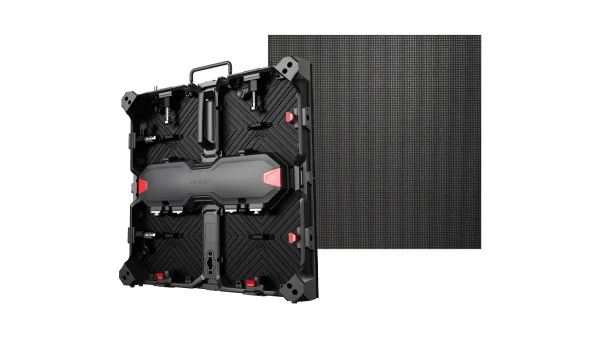
Telewizor LED COB typu „wszystko w jednym”
  Elastyczne wyświetlacze LED
  Przezroczyste wyświetlacze LED
  Plakat LED
  Okrągłe wyświetlacze LED
  Kreatywne i niestandardowe wyświetlacze LED
 dwa wyświetlacz LED do wypożyczenia na zewnątrz panels can both claim IP65, 5,000-nit brightness, and a five-year design life on their spec sheets. One will run reliably for eight years. The other will develop chronic failures after eighteen months. The difference is never in the LED chips — it is in the thermal design, the ingress protection execution, and the component choices around the LEDs. Here is what to inspect before you specify.

- Most outdoor LED panel failures are not dead LEDs — they are power supply failures from thermal stress, moisture ingress at connectors, and capacitor degradation accelerated by heat.
- IP65 is a lab test under static conditions. It does not guarantee performance after repeated rental assembly/disassembly cycles, thermal expansion, or driving rain at an angle.
- Every 10°C above a component’s rated temperature roughly halves its lifespan. An outdoor panel running hot in direct sun will see capacitor failures years before its nominal design life.
- Connector quality — gold-plated contacts, rated cycle life, IP67 sealing — is one of the most underestimated factors in long-term outdoor rental reliability.
The Real Failure Modes: Not What the Datasheet Tells You
Kiedy wyświetlacz LED do wypożyczenia na zewnątrz panels fail in field service, the failures cluster around three causes — and none of them are the LEDs themselves:
Power supplies have rated operating temperatures — typically 50–60°C. Outdoor enclosures in direct sun regularly exceed these temperatures unless thermal management is properly designed. Once the power supply fails, the entire panel goes dark.
Panel-to-panel connectors, cable glands, and service panels are the weak points. IP65 tests static, sealed conditions — not field conditions with thermal cycling, vibration, and repeated assembly in rental applications.
Electrolytic capacitors in driver boards and power supplies have lifetimes that approximately halve for every 10°C above their rated temperature. An outdoor panel running hot will see capacitor failures years before its nominal design life.
Most “dead pixel” failures in outdoor panels are actually driver circuit failures behind the LEDs — not failed LED chips. Modern LED chips are remarkably robust when not subjected to excessive current or temperature.
Thermal Design: The Variable That Determines Real Panel Lifespan
Outdoor LED panels in direct sunlight absorb significant solar heat through the front face — often 200–400 W/m² beyond the heat generated internally by the panel electronics. If the panel cannot reject this heat efficiently, internal temperatures rise and every electronic component inside ages faster.

Four thermal design factors to evaluate
| Współczynnik termiczny | Czego szukać | Czerwona flaga |
|---|---|---|
| Module-to-cabinet thermal coupling | Designed thermal path from LED module substrate through cabinet body to ambient | Module floating in air with poor conduction to cabinet |
| Cabinet ventilation strategy | Convection or forced ventilation matched to brightness class | Sealed box with no ventilation at 6,500 nits — thermal runaway |
| Power supply heat sinking | Generously sized aluminium heat sinks with thermal interface to cabinet | Minimal heat sink — cost-cutting on the most failure-prone component |
| Brightness vs temperature derating | Published brightness vs temperature curves, not just peak at 25°C | Only peak brightness quoted — real summer performance unknown |
Ask your supplier: “Can you provide thermal test data at 40°C ambient with full white-screen content?” This is the relevant operating condition for an outdoor summer festival — not lab-bench peak performance. Suppliers with confidence in their thermal design will produce this data. Those without it will deflect.
IP Rating in Rental: What IP65 Actually Means — And What It Doesn’t
IP65 is the standard claim for wyświetlacz LED do wypożyczenia na zewnątrz panels. The test certifies protection against water jets from any direction, under specific static conditions in a laboratory. That is the whole test. Here is what it does not guarantee in the real world.
- Long-term humidity ingress. A panel can pass IP65 testing and still develop slow moisture infiltration over months of thermal cycling
- Performance after repeated assembly. Rental subjects the IP seal to repeated stress. Each assembly cycle is a potential degradation event at the gasket
- Connector integrity. Inter-panel connectors and signal/power input connectors are the weakest point. IP65 panel body with a poor-quality connector compromises the system
- Driving rain plus wind. Rain at the right angle and wind speed can exceed IP65 test conditions in a real festival environment
- IP65 front face with IP54 or better rear face and active drainage design
- Sealed connectors rated to IP67 or higher in mated condition
- Gasket designs that maintain seal integrity across the thermal expansion range expected in outdoor use (-20°C to +60°C)
- Documented driven-rain testing or water immersion testing beyond basic IP65 certification
- Dust cap standard on all connectors for protection during transport and storage
A permanently installed outdoor LED wall gets sealed once and stays sealed. A rental panel gets assembled, disassembled, transported, and reassembled — potentially 40+ times a year. Each cycle stresses the same gaskets and seals that passed a single static lab test. This is why rental-specific outdoor products need higher-grade sealing and more robust connector designs than their fixed-install equivalents.
Matrix 500 and X-1000 outdoor rental models are IP65 rated with sealed connectors and active drainage. See the full IP rating comparison across our four rental LED series.
The Connector Question: Why It Matters More Than the Panel Body
In rental applications, connectors are connected and disconnected hundreds of times over the life of the product. Connector quality is one of the most underestimated factors in long-term outdoor rental LED reliability — and it is exactly where cheaper panels cut costs first.
- Gold-plated contact surfaces — not just gold-flashed
- Designed insertion/withdrawal cycle life of 500–1,000 cycles
- IP67 or better sealing in mated condition
- Strain relief that prevents cable damage at the connector body
- Polarised and keyed mating to prevent incorrect connection
- Intermittent signal loss on individual panels
- Colour drift on panels with degraded signal connections
- Power glitches under stage vibration or wind
- Visible corrosion on contact surfaces after outdoor use
- Connector housing cracks from repeated mating stress
What connector brand and model does your supplier use, and what is the rated mating cycle count? If they cannot name the brand — or the cycle rating — assume the connectors are the cheapest available and budget for replacement within two touring seasons. Quality connectors from Neutrik or Seetronic cost more per panel but last the life of the product.
Component Specification Beyond the LED: Power Supplies & Driver Electronics
Spec sheets rarely call out components by brand name. This is intentional — it allows suppliers to substitute cheaper alternatives without changing the published specifications. Two components determine real-world lifespan more than any other:
1. Power supply quality
Industrial-grade power supplies from established manufacturers — Mean Well, Delta, Murata — cost more but deliver dramatically better field reliability than generic alternatives. The cost difference is typically $5–15 per panel. The reliability difference is measured in years of operational life.
Why this matters for outdoor rental specifically: outdoor panels run at high brightness (4,500–6,500 nits) for extended periods in direct sun — this is maximum power supply load, at maximum ambient temperature. The power supply is the single component most likely to fail first under these conditions.
2. Receiving card and driver IC choices
Established receiving card brands — Novastar, Linsn, Colorlight — deliver consistent performance across production batches. Generic or no-name alternatives may work initially but show problems over time: colour drift between panels, refresh rate instability, greyscale degradation at low brightness. For rental applications where panels from different production batches get mixed on a single stage, consistent driver behaviour is essential.
You have to ask. A spec sheet will say “power supply: 200W” — it will not say whether that power supply is a Mean Well LRS-200-5 or a generic equivalent that costs half as much and lasts a quarter as long. Ask for the component brand and model number for power supply, receiving card, and driver ICs. If the supplier will not provide this information, there is a reason.
The Five-Year View: What to Verify Before You Commit
Jeśli określisz wyświetlacz LED do wypożyczenia na zewnątrz panels with a five-year operational expectation — which is standard for a rental company building long-term inventory — you need to verify these five things before placing an order:
- Thermal performance at realistic ambient temperatures. Not lab-bench peak brightness at 25°C. Demand test data at 40°C with full white, running for a minimum of 4 hours — the thermal steady-state condition for a summer festival.
- IP performance under rental-application stress. Not a single static lab test. Ask about gasket material, compression set resistance over thermal cycling, and whether the supplier has tested IP integrity after 50+ assembly/disassembly cycles.
- Connector quality and cycle ratings. Brand name, model number, rated mating cycles, contact material, and IP rating. If any of these are missing, the connectors are the cheapest available and will be your first failure point.
- Brand-name power supplies and driver electronics. Mean Well or equivalent for power supplies. Novastar, Linsn, or Colorlight for receiving cards. If the supplier substitutes generic components, the upfront saving disappears in maintenance costs — usually within two years.
- Manufacturer track record on field failures. Ask for references on outdoor rental installations that are 3+ years old. Talk to those references about what failed and how the supplier handled it. A supplier with no 3-year field references is a supplier whose product has not been in the field long enough to have a track record.
A panel that scores well on all five will cost more upfront. It will cost less over five years. The math is not complicated — a single festival-season failure that requires emergency replacement panels and crew overtime costs more than the upfront premium on every panel in the order.
For the full specification breakdown including IP ratings across all four rental LED series, see the rental LED comparison table.
Send your venue type, typical weather conditions, and screen size. An engineer confirms the right IP rating, brightness class, and thermal spec — with verified production data, not marketing numbers.